
Tap water is not automatically bad for an aquarium, and reverse-osmosis water is not automatically better. The useful question is whether you can identify your source water, prepare it safely and consistently, and keep conditions appropriate for the freshwater animals and plants you actually own.
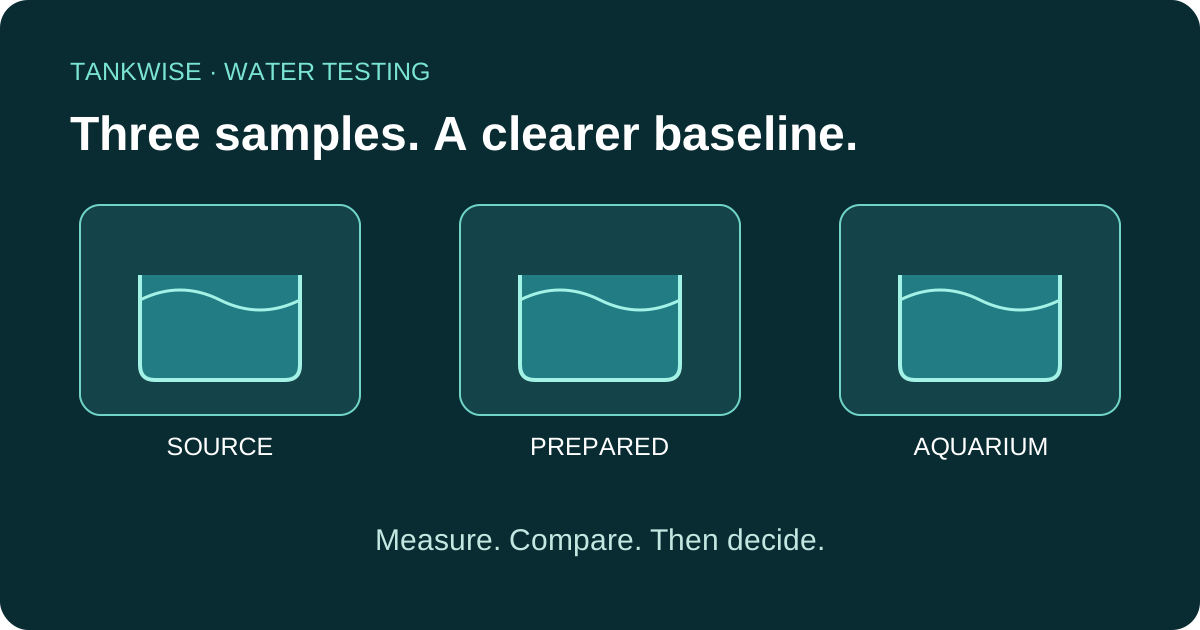
Before changing pH, GH, KH or total dissolved solids, compare three different samples:
Those samples answer different questions. Treating them as one number is how a manageable water-supply choice turns into repeated chemical adjustments.
Content transparency
AI-generated draft, human-reviewed publication
This guide was drafted with generative AI used to organize research and prepare an initial version. The AI output was not treated as an authority or source. Simon from the Simply Submerged Aquatics team reviewed the published guide for accuracy and completeness within the scope recorded below.
What the human review covered
- Review attribution and publication approval supplied by Simon for this source-water article.
Key takeaways
- Compare source water, prepared change water and aquarium water separately.
- Identify the disinfectant and follow the exact treatment label.
- Measure the prepared result; avoid universal mixing ratios or chemistry targets.
- A top-off replaces evaporation; it does not replace a water change.
The three waters every freshwater keeper should separate
1. Source water
Source water is the water before aquarium-specific preparation. It may come from a municipal tap, private well, household softener, RO unit, distilled-water container or bottled-water supplier.
This sample helps you answer:
- Where did the water come from?
- Does the supplier use chlorine or chloramine?
- Are nitrate, pH, GH, KH or total dissolved solids already present before the water reaches the aquarium?
- Is a household treatment system changing the supply?
2. Prepared change water
Prepared water is what will actually enter the aquarium after the normal process is complete. That process might include a conditioner, temperature adjustment, mixing tap and RO water, or remineralizing RO water according to a product label and a species-aware plan.
This sample tells you whether the process is repeatable. It is the most useful comparison for an ordinary water change because it represents the water you are about to add.
3. Aquarium water
Aquarium water is what the fish, invertebrates and plants currently experience. It can differ from prepared water because of:
The difference between prepared water and aquarium water is often more informative than either reading alone.
- nitrification and other biological activity;
- feeding, waste and decaying organic material;
- active substrate, rocks, wood and plant growth;
- fertilizers, buffers, medications or other additions;
- evaporation and top-offs; and
- the timing and volume of water changes.
Municipal tap water: start with the supplier, not an assumption
In the United States, community water systems provide an annual Consumer Confidence Report. The report identifies the source and lists regulated contaminants detected in the supply. It is valuable context, but it is not an aquarium care sheet and may not list GH or KH in the form an aquarium test uses.
Check the report and the utility's current information for the disinfectant. The U.S. EPA states that chlorine and monochloramine must be neutralized or removed before chlorinated or chloraminated water is used in an aquarium because these disinfectants can harm fish and interfere with beneficial bacteria.
Use a water conditioner that explicitly covers the disinfectant your utility uses. Follow the current label for the exact product, preparation method and volume being treated. Product directions may differ for water prepared separately and water treated during refilling. Do not rely on a copied capful, a different brand's dose or a claim that leaving every type of tap water standing will make it ready.
Then test the source sample with the same aquarium methods you use for later comparisons. A utility report and an aquarium test solve different parts of the problem:
If the utility announces a treatment change, flushing program or advisory, treat that as a reason to refresh the baseline.
- the utility report describes the regulated public supply;
- the aquarium test describes the sample and parameters you measured; and
- the prepared-water sample verifies the process you intend to repeat.
Private well water: aquarium tests do not replace a laboratory
Private wells are not regulated, treated or monitored in the same way as community water systems. The U.S. CDC recommends testing well water at least annually for total coliform bacteria, nitrate, total dissolved solids and pH, using a state-certified laboratory, with additional local contaminants chosen with the health department.
That is a human-safety program. An aquarium kit that reads nitrate and pH cannot rule out bacteria, metals, pesticides or other local concerns.
For aquarium planning:
Retest after flooding, well repair, a noticeable change in color, smell or taste, or another event identified by local health guidance. Do not diagnose an aquarium problem from “well water” as a label; the measured supply and local geology matter.
- keep the current laboratory report and local health guidance;
- record whether water passes through a household softener or other treatment before reaching the aquarium tap;
- test aquarium-relevant parameters in the source sample; and
- build the prepared-water sample using the same process you will use each time.
RO and distilled water: useful tools, not complete care plans
Reverse osmosis removes much of the dissolved material from source water. Distillation also produces water with very little dissolved mineral content. That can make either useful when the original supply is unsuitable for a carefully researched goal.
It does not make untreated RO or distilled water a universal freshwater recipe.
Alkalinity describes water's acid-neutralizing capacity and helps buffer pH. Hardness is related but different and commonly reflects calcium and magnesium. Freshwater species do not all have the same requirements, and breeding, egg, larval and adult needs may differ.
If you use RO or distilled water:
Do not use a universal tap-to-RO ratio copied from another aquarium. Two homes can have different tap water, two RO units can produce different output, and two aquariums can contain species with different needs.
If the only goal is to force a pH number, pause. pH is connected to alkalinity, dissolved carbon dioxide and the aquarium system. Reducing dissolved material without understanding those relationships can trade one confusing reading for an unstable process.
- define the goal from credible species information rather than a generic ideal;
- decide whether the plan uses remineralized RO, a measured mix with another source, or a purpose-made product;
- follow the exact remineralizer or treatment instructions;
- prepare water outside the occupied aquarium unless the product explicitly directs otherwise;
- verify the prepared result before use; and
- reproduce the same process at later changes.
Household-softened and bottled water need their own baseline
A household ion-exchange softener is not the same as an RO unit. Depending on the regenerant, it replaces calcium and magnesium ions with sodium or potassium. Water described as “softened” may therefore have low measured hardness without having low total dissolved material.
If a home has a softener, identify whether the aquarium tap is before or after it. Compare both only when it can be done safely and without altering household plumbing. Choose the source based on measured chemistry and the intended livestock, not the word “soft.”
Bottled labels such as spring, purified or drinking water also do not supply a complete aquarium profile. Products and sources can vary. If bottled water will be used repeatedly, check the supplier information, test a sample, and decide whether the cost and supply are realistic for the aquarium's long-term water-change volume.
Build a three-sample baseline before adjusting anything
Use clean aquarium-only containers and follow every test instruction, including sample volume, shaking, timing, lighting and units.
Step 1: map the source path
Write down:
- municipal supply, private well, RO, distilled, bottled or another source;
- any household softener, carbon filter or RO stage in the path;
- the utility's stated disinfectant, if applicable; and
- the date of the utility report, laboratory report or product batch information.
Step 2: test the source sample
At minimum, record the parameters relevant to the problem and livestock plan. Common useful context includes temperature, pH, GH, KH or alkalinity, nitrate, ammonia and nitrite. Not every source requires every aquarium test every time; the first purpose is to establish what enters the preparation process.
Keep the value, unit, method and date together. “KH 4” is incomplete without the scale or unit.
Step 3: prepare change water normally
Use the actual volume, product labels and repeatable process you intend to use. Record:
- volume prepared;
- conditioner, remineralizer or other product and dose;
- tap-to-RO proportion, if used;
- temperature; and
- time and method of mixing.
Step 4: test the prepared sample
Use the same methods and units. If the result is surprising, repeat the test before adding another chemical.
Step 5: test the aquarium sample
Take the aquarium sample at a consistent point in the maintenance cycle, such as immediately before the normal water change. Record recent feeding, fertilizers, medications, top-offs, maintenance and any major change to plants, substrate or livestock.
Step 6: repeat the comparison
One set of readings is a snapshot. Repeat the three-sample comparison over several normal maintenance cycles. A stable pattern is more useful than an isolated number.
Change one variable at a time. If the source, conditioner, RO ratio and remineralizer all change together, the next test cannot tell you which change mattered.
Read the pattern before changing chemistry
This table is a triage framework, not a diagnosis. Visible animal distress, suspected contamination or repeated unexplained changes may require help from an aquatic veterinarian, qualified fish-health professional, water utility, certified laboratory or local health department, depending on the problem.
| Pattern | What it suggests | Safer next step |
|---|---|---|
| Source and prepared water are similar, repeatable and appropriate for the livestock plan | The current preparation may already be sufficient | Keep the process consistent; do not adjust simply to reach an internet target |
| The utility uses chlorine or chloramine | Aquarium water needs source-appropriate treatment before use | Confirm the disinfectant and follow a conditioner label that covers it |
| Source nitrate or another result is unexpectedly high | The issue may begin before the aquarium | Repeat the aquarium test, compare the utility or certified-lab information, and seek qualified local advice before choosing treatment |
| Prepared water changes from batch to batch | The preparation method is not yet reproducible | Check true volume, dose, RO ratio, product mixing and test procedure |
| Aquarium pH, GH or KH gradually diverges from prepared water | Something in the aquarium or maintenance routine is changing the water | Review substrate, rocks, fertilizers, buffers, evaporation, top-offs, biological activity and dated notes |
| A single result is very different from the established pattern | It may be a real event or a test/process error | Repeat carefully before making a large correction; protect welfare if animals show distress |
| Source water is far from a candidate species' researched needs | The fish-store decision includes a long-term water-preparation commitment | Decide whether a stable, repeatable plan is realistic before purchase |
Top-offs and water changes solve different problems
Evaporation removes water while dissolved material is generally left behind. A top-off restores water volume; it does not remove the nitrate, minerals and other dissolved material that remained in the aquarium.
A water change removes a portion of aquarium water and replaces it with prepared water. Merck Veterinary Manual identifies repeated topping-off without adequate water exchange as one route to old tank syndrome.
That does not mean every aquarium needs the same water-change percentage or schedule. Stocking, feeding, plants, source water, measured trends and species all matter. It means a top-off and a water change should not be treated as interchangeable entries in the record.
If RO or distilled water is used for top-offs, that choice should still belong to an intentional whole-tank plan. Do not assume a top-off method also defines the correct water-change mix.
Bring the real baseline into the fish-store decision
The fish-store moment contains two separate questions:
Source water affects the second question because the aquarium must remain maintainable after the fish comes home. A species may be theoretically possible in carefully prepared water while still being a poor fit for the routine, supply and experience you can sustain.
Prefer a stable process you can repeat over a dramatic number you can reach once. TankWise can keep the aquarium's actual volume, saved water baseline, current livestock and plants together for the comparison. Keep source and prepared-water readings in clearly labeled dated notes, separate from the tank water log, so they do not replace the aquarium baseline used for comparisons.
TankWise does not test water, diagnose fish, certify health, guarantee compatibility or replace quarantine and species research. It keeps the context together so the final judgment is based on the aquarium you own rather than a detached target value.
- Does this individual fish and the wider sales system look suitable to consider, based on species-aware observation?
- Does the species fit the aquarium you actually own, including adult size, social needs, temperature, water, current livestock and selected risk signals?
Three-sample water baseline record
| Record | What to include |
|---|---|
| Sample identity | Source, prepared water or aquarium; date and time |
| Source and preparation | Supply, treatment path, product and dose, mixing ratio, volume |
| Measurements | Temperature, pH, GH, KH/alkalinity and relevant nitrogen tests; record units and methods |
| Context | Recent tank changes, top-offs, maintenance and next check |
Keep the baseline with the aquarium
Download TankWise free on Google Play and save one freshwater aquarium's actual volume, water baseline, livestock and plants. Keep aquarium readings in the tank water log; use clearly labeled dated notes for source and prepared-water readings so the next water change—or fish-store decision—starts with evidence instead of memory.
Editorial transparency
Prepared with AI research and editorial assistance for Simply Submerged Aquatics. Reviewed by Simon, as confirmed for publication by Simon. This does not constitute veterinary review.
Sources and further reading
These references provide scientific or technical background and disclose how TankWise works. External references do not imply that every current TankWise catalog value was sourced from, or reviewed by, those organizations. See the checker methodology and known limits for that distinction.
- Chlorinated and chloraminated water in aquariumsU.S. EPA
Supports neutralizing or removing chlorine and monochloramine before aquarium use; it does not prescribe a brand or dose.
- Consumer Confidence ReportsU.S. EPA
Explains annual U.S. community-water reports and the source and contaminant information they contain.
- Guidelines for testing well waterU.S. CDC
Supports annual certified-laboratory testing and additional testing after relevant events. This concerns human drinking-water safety, not aquarium-kit certification.
- Water analysis: alkalinity and hardnessUF/IFAS Extension
Used only for definitions of alkalinity, buffering and hardness. Its irrigation thresholds and treatment methods are not aquarium recommendations.
- WaterSense guide to selecting water treatment systemsU.S. EPA
Explains treatment methods and matching treatment to measured needs; it is not a species-specific aquarium recipe.
- Home water softening FAQMinnesota Department of Health
Explains exchange of calcium and magnesium for sodium or potassium. Low hardness does not mean the water is equivalent to RO output.
- Management of aquarium fishMerck Veterinary Manual
Supports water-quality monitoring and the distinction between topping off and exchanging water. No universal treatment dose is inferred.
- Freshwater water testingTankWise
Use the existing guide for consistent testing methods.
- Recording aquarium water resultsTankWise
Keep the sample identity, date, unit and method with the record.
- Tank context and fish compatibilityTankWise
Connect the measured aquarium baseline to a new-fish decision.
Frequently asked questions
Can I use tap water in a freshwater aquarium?
Often, but “tap water” is not one chemistry. Identify the supply and disinfectant, neutralize or remove chlorine or chloramine with an appropriate aquarium product, test the parameters relevant to the intended livestock, and verify the prepared result. Follow current utility notices and product labels.
Is RO water always better than tap water?
No. RO is a water-treatment tool, not a complete freshwater recipe. It can help create a planned chemistry when the original supply is unsuitable, but the output still needs to be measured and may need a consistent remineralization or mixing process.
Can I use pure RO or distilled water by itself?
Do not assume it is appropriate for every freshwater animal. Purified water contains very little hardness and buffering. Choose a species-aware preparation plan and verify the result rather than using untreated purified water as a universal default.
Can I leave tap water standing instead of using conditioner?
Do not rely on standing water as a universal treatment. Utilities may use chlorine or longer-lasting chloramine. Identify the disinfectant and use a product whose label covers it.
Why is aquarium pH different from tap-water pH?
Water can change after collection and inside the aquarium. Carbon dioxide, alkalinity, nitrification, substrate, rocks, plants and additives can all influence the result. Test samples at consistent stages and look at KH or alkalinity alongside pH before changing anything.
Is softened household water the same as RO water?
No. A common ion-exchange softener replaces calcium and magnesium with sodium or potassium; RO removes a broader range of dissolved material through a membrane. Identify which system supplies the aquarium tap and test the result.
Is a TDS reading enough to choose aquarium water?
No. TDS is an aggregate measure and does not identify which dissolved substances are present. It can help track a consistent process, but it does not replace source information, GH, KH or alkalinity, pH, nitrogen tests and species research.
How often should I retest source water?
Create a baseline, then retest when the utility or treatment process changes, after relevant well events, when a new batch or source is introduced, or when aquarium results stop matching the established pattern. For human safety, follow public-health guidance; the CDC recommends at least annual testing for specified private-well indicators.
Does topping off replace a water change?
No. A top-off replaces water lost to evaporation. A water change removes a portion of aquarium water and the substances dissolved in it before replacement. Record them as different actions.